Real progress in Jiu-Jitsu comes from doing the basics well, consistently, in a room that keeps you challenged and safe.
If you’re searching for Jiu-Jitsu in Spokane Valley, you’re probably looking for more than a workout. You want strength that shows up in daily life, skills that hold up under pressure, and the kind of confidence that comes from knowing you can handle yourself without needing to “feel tough” all the time.
We built our adult program around exactly that: measurable improvement, week after week, without burning you out. Jiu-Jitsu is demanding, but it’s also surprisingly logical once you learn how positions connect and why small details matter. And yes, you can start as a total beginner. Most people do.
A lot of adults hesitate because of time, nerves, or the injury question. Those are fair concerns. The good news is that smart training habits and instructor-led structure go a long way, especially early on, when learning control and movement matters more than “winning” anything.
What makes Jiu-Jitsu different for adults
Jiu-Jitsu gives you a real skill that grows with you. It’s not just cardio or lifting or stretching, even though you’ll get plenty of all three. You’re learning how to solve physical problems: escaping bad positions, controlling an opponent, and staying calm when your heart rate climbs.
For adult Jiu-Jitsu in Spokane Valley, that problem-solving aspect matters because adult life is already full. You don’t need another thing that’s vague or random. You need training that’s structured, progressive, and worth your time.
We teach the fundamentals in a way that lets you feel the “why” behind each move. When you understand why a frame works, why an underhook changes everything, or why posture breaks lead to submissions, you start improving fast, even if you’re not naturally athletic.
Strength that actually carries over
People often think Jiu-Jitsu strength means big muscles. Sometimes it does, but the more useful kind is connected strength: grip endurance, hip control, core stability, and the ability to generate pressure without overexerting yourself.
That strength shows up when you:
- Hold posture under stress instead of folding
- Maintain balance while moving someone who wants to move you
- Use your legs and hips instead of just your arms
- Breathe and think clearly when positions get tight
It’s a different feeling than a standard gym session. You’ll still get sore (in a satisfying way), but you’re building capability, not just fatigue.
How our training approach builds skill faster
We emphasize technical development first, then controlled intensity. That might sound simple, but it’s the difference between learning Jiu-Jitsu and just surviving rounds.
In class, we focus on:
- Clear instruction and demonstration so you know what success looks like
- Reps with coaching so you don’t practice mistakes for months
- Positional training to isolate a situation and improve it quickly
- Live rolling with expectations around safety and control
One thing adults appreciate is that there’s a plan. You’re not guessing what to do next. You’re learning a system: position, pressure, timing, and decision-making.
The “small details” that change everything
In Jiu-Jitsu, an inch matters. A slightly better angle on a guard pass, a tighter elbow position on a choke, a calmer base in side control. Those details aren’t flashy, but they’re what make the art work.
We’ll coach you on the things beginners usually miss, like:
- When to relax so you don’t gas out
- How to use frames to create space, not just push
- How to move your hips before you move your head or arms
- How to recognize danger early instead of late
Over time, you stop feeling like you’re reacting to everything. You start seeing patterns, and that’s when confidence gets real.
Confidence you can feel outside the gym
Confidence from Jiu-Jitsu isn’t about acting fearless. It’s quieter. It’s knowing you’ve been in uncomfortable positions and learned how to get out. It’s trusting your ability to problem-solve under pressure.
For many adults, that carries over into work and home life in practical ways:
- Better stress tolerance because you’re used to staying calm when it’s intense
- More body awareness and posture, which helps with daily aches
- A stronger sense of boundaries because you’ve trained control and composure
- A real feeling of progress that doesn’t depend on a scale
And honestly, sometimes it’s as simple as walking around Spokane Valley feeling a little more capable in your own skin.
Belt progression: what to expect as an adult
One of the most common questions we hear is how long it takes to “get good.” The honest answer is that Jiu-Jitsu is a long game, but it’s not a slow game if you train consistently.
Research on Brazilian Jiu-Jitsu belt timelines shows average time to earn early belts around 2 to 3 years each, with advanced ranks taking longer. One set of averages puts white belt at about 2.3 years to reach the next level, blue belt taking another 2.3 years to earn, purple belt around 5.6 years to earn, and brown belt about 9.0 years to earn. Those numbers vary person to person, but they’re useful for setting expectations.
What we want you to hear is this: you don’t have to wait years to feel progress. You’ll feel it within weeks if you train with intent. The longer timeline just reflects how deep the skill can get.
A practical training rhythm that fits adult schedules
If you’re starting adult Jiu-Jitsu in Spokane Valley, more is not always better. A smart starting point for most adults is 2 to 3 classes per week. That’s enough frequency to build skill and conditioning without spiking fatigue or nagging soreness.
As your body adapts, we can help you scale up in a way that keeps you improving, not limping.
Safety and injury prevention: a realistic conversation
Let’s be direct: Jiu-Jitsu is a contact sport, and injuries happen. A 2019 study reported 59.2 percent of athletes experienced at least one injury in the prior 6 months. Injury risk also tends to rise with belt level, and advanced athletes can face serious injuries that pull them from training.
That said, risk is not destiny. How you train matters. Volume, intensity, and the culture of the room all influence how safe your experience is, especially as a beginner.
We take a methodical approach so you can train hard and still train tomorrow. That includes coaching you to choose control over force, tap early, and build durability over time.
How we help you train smarter from day one
Here are habits we encourage immediately because they reduce avoidable injuries and speed up learning:
• Start with 2 to 3 classes per week so your joints and neck adapt gradually
• Tap early and often while you learn the difference between pressure and danger
• Prioritize positional escapes and defense so you don’t panic in bad spots
• Roll with control and communicate, especially with size or experience gaps
• Add basic strength and mobility work so your body supports the skill you’re building
You’ll still have tough days. That’s part of training. But tough should mean challenged, not reckless.
What a typical class feels like (and what you’ll actually do)
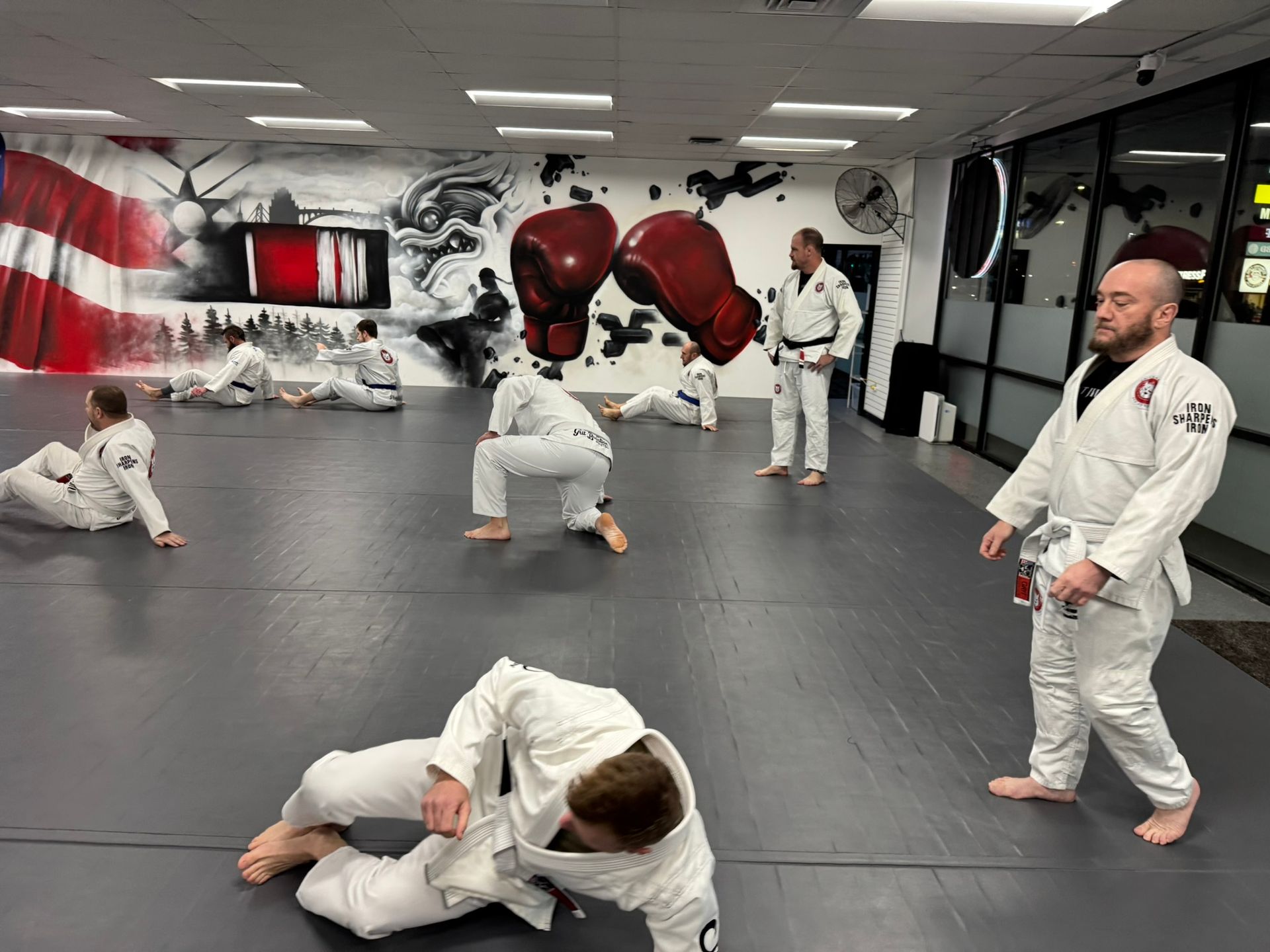
Walking into your first Jiu-Jitsu class can feel like stepping into a new language. We keep the environment welcoming, but we also keep it real. You’ll sweat. You’ll learn. You might laugh when something finally clicks because, yes, that happens.
A typical class includes:
- Warm-ups that support grappling movement, not random calisthenics
- Technique instruction with a clear goal for the day
- Partner drilling with coaching and corrections
- Controlled sparring or positional rounds to apply the skill
- A quick wrap-up so you leave knowing what to focus on next time
You don’t need to “get in shape first.” Training is how you get in shape, and we’ll meet you where you are.
Why Muay Thai cross-training pairs well with grappling
Even though this article focuses on Jiu-Jitsu, we also coach striking, and that matters for adults who want well-rounded ability. Grappling teaches control and leverage. Striking develops timing, distance management, and conditioning in a different way.
If your goals include self-defense confidence, cross-training can be a practical option. You learn how range changes, how clinch control matters, and how to stay composed when the pace rises.
We’ll help you balance the two so you’re not doing everything at once and doing none of it well.
Jiu-Jitsu in Spokane Valley for real life, not just the mats
Our community includes adults with desk jobs, shift work, parenting schedules, and all the usual Spokane Valley routines. What connects everyone is the decision to build a skill that changes how you carry yourself.
Over time, you’ll notice:
- Better movement quality, especially hips and shoulders
- More patience under pressure
- More confidence in close-contact situations
- Stronger relationships in the room because you’re learning with partners, not alone
Jiu-Jitsu rewards consistency. If you show up, stay curious, and train with control, the results follow.
Take the Next Step
Building strength, sharpening skill, and gaining confidence is exactly what our mats are for, and we keep the path clear so you always know what to work on next. If you’re ready to start Jiu-Jitsu in Spokane Valley with a structured adult program, we’ll help you train hard, learn fast, and do it in a way that respects your body and your schedule.
At Grit Jiu-Jitsu & Muay Thai Martial Arts, we make it easy to begin, whether your goal is fitness, self-defense, or simply doing something challenging that makes you better over time.
Develop strong fundamentals and take your training to the next level by joining a Jiu-Jitsu class at Grit Jiu-Jitsu & Muay Thai Martial Arts.