
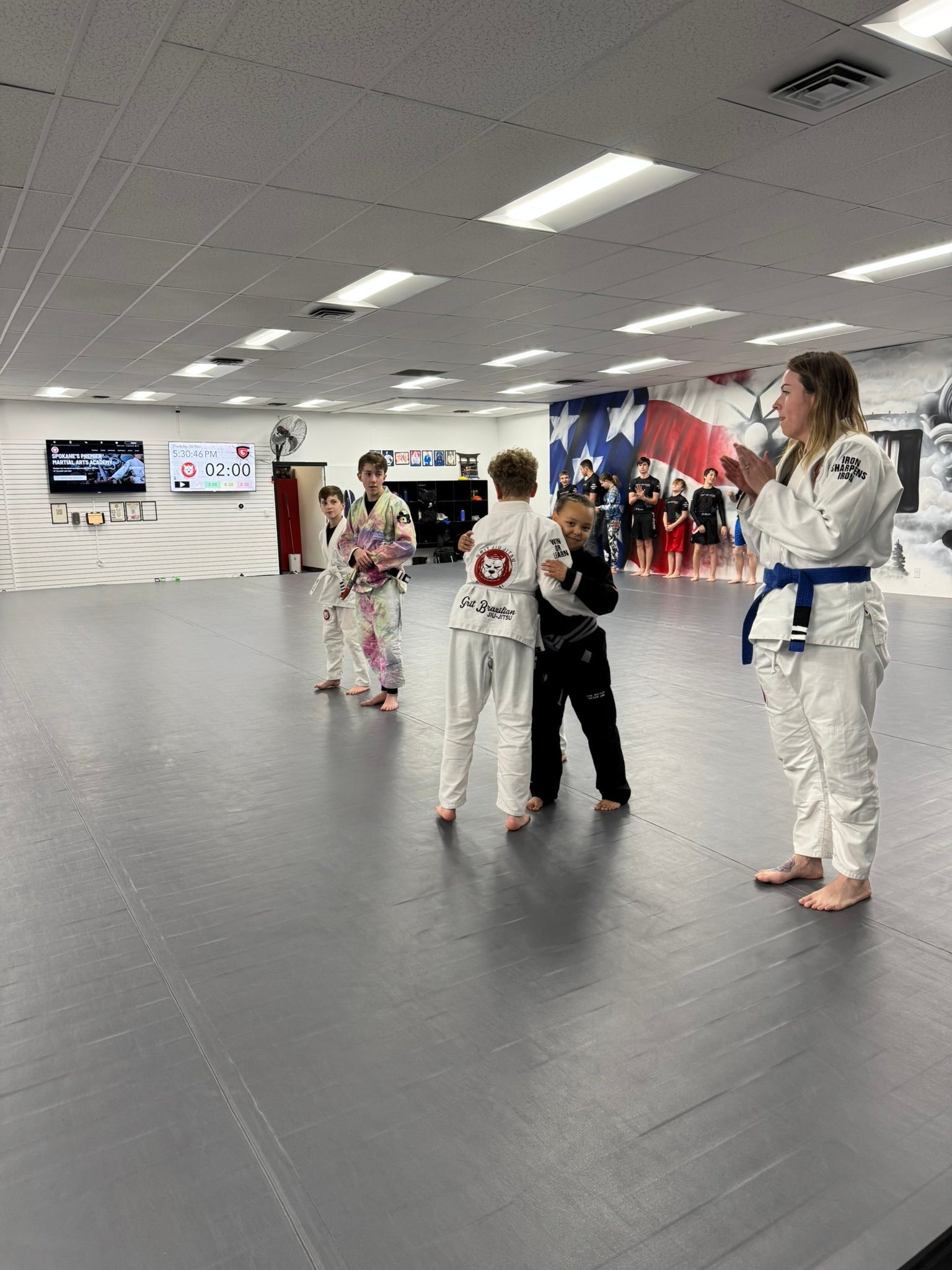
Youth Jiu-Jitsu gives kids a place to build real confidence through structure, movement, and steady wins.
Parents in Spokane Valley ask us a lot of the same questions: Will my child actually stick with it? Is it safe? Will it help with focus and behavior at home and school? Youth Jiu-Jitsu is one of the few activities that answers those questions with a clear, repeatable process: show up, learn a skill, practice it with a partner, and improve a little each week.
This growth is not just happening locally. Children under 16 now make up 22% of global academy enrollments, which lines up with what we see on the mats: families want training that builds discipline, not just something that burns energy for an hour. At the same time, Jiu-Jitsu in Spokane Valley is benefiting from a national wave of interest, with Brazilian Jiu-Jitsu search growth rising more than 100% over the past two decades, making it the fastest-growing martial art in the U.S.
In this guide, we will walk you through what Youth Jiu-Jitsu in Spokane Valley can look like in real life: how classes are structured, what your child learns first, how we keep training safe, and how consistent practice turns into better decision-making, stronger boundaries, and calmer confidence.
Why Youth Jiu-Jitsu is growing so fast and why that matters for your family
Youth Jiu-Jitsu is growing because it meets kids where they are. It is physical, but it is also strategic. Kids get to move, but they also have to think. That mix tends to click for a wide range of personalities, from the high-energy child who needs a productive outlet to the quiet child who needs a structured way to speak up with their actions.
There is also a larger shift in youth activities toward programs that teach life skills through sport. The sport segment of the market has become the dominant category, which reflects what many parents want: a structured environment where effort is visible and progress is measurable. That matters because kids respond well to clear expectations, and Jiu-Jitsu naturally provides them.
And yes, it is a real sport with real momentum. Around 6 million people practice Jiu-Jitsu worldwide, with about 750,000 in the U.S., and the U.S. Brazilian Jiu-Jitsu studios industry is projected to reach 2.5 billion dollars in 2026. Those numbers are big, but the takeaway is simple: you are not putting your child into a fad. You are stepping into a proven training culture that is still early enough in many cities, including Spokane Valley, to feel fresh and community-driven.
What your child actually learns in our Youth Jiu-Jitsu program
A good kids program is not a mini version of adult training. Kids learn differently, and the class has to reflect that. We keep lessons clear, repeatable, and layered, so your child can succeed early without getting bored later.
The foundation: movement, balance, and safe body control
Before a child “does Jiu-Jitsu,” we help your child learn how to move like an athlete. That means base, posture, balance, and controlled intensity. If you have ever watched a kid try to sprint in flip-flops, you know why this matters. When movement improves, everything else improves with it, from confidence to coordination.
We build this foundation with simple drills that teach:
- How to fall and roll safely
- How to keep balance while being pushed or pulled
- How to use hips and legs for power instead of flailing arms
- How to stay calm while someone is close and pressure is real
Those skills carry into everyday life more than people expect, especially for kids who get overwhelmed by contact sports or crowded environments.
The core: leverage and position before submissions
Youth Jiu-Jitsu works best when kids learn that position comes first. We focus on how to control distance, escape bad spots, and improve to safer, stronger positions. Submissions are taught with age-appropriate rules and strong supervision, but we never treat taps casually. Tapping is communication, and we teach it as a smart choice.
For most kids, the early “aha” moment comes when your child realizes size is not the whole story. Technique can change outcomes. That lesson alone often shifts how kids carry themselves at school and on the playground.
How our class structure supports discipline without feeling harsh
Discipline sticks when it feels fair. Our goal is not to make kids “tough” in a performative way. It is to help your child build dependable habits: listening, trying, resetting after mistakes, and treating partners with respect.
A typical class rhythm includes:
1. Quick check-in and clear expectations for the day
2. Warm-up drills that teach athletic movement, not random exhaustion
3. Technique instruction with simple coaching cues kids remember
4. Partner practice with active coaching and frequent resets
5. Controlled games or situational rounds that make skills feel real
6. Wrap-up that reinforces what went well and what to focus on next
That structure matters because it creates predictability. Kids do not have to guess what comes next, so they can relax and focus. Over time, the mat becomes a place where your child learns, “If I follow the process, I improve.” That mindset is discipline, and it transfers.
The truth about safety in Youth Jiu-Jitsu and how we reduce risk
We take safety seriously, and we also talk about it honestly. Pediatric injury rates in Brazilian Jiu-Jitsu have shown a statistically significant increasing trend from 2012 to 2021, with most injuries treated in emergency departments without admission. The most common pediatric injury types reported include sprains and strains and fractures, and the most frequently injured areas include the head, shoulder, and lower arm, with an average injured child age around 11.6.
That sounds concerning until you add context: Brazilian Jiu-Jitsu has historically shown a lower injury rate per 1,000 athlete exposures compared with judo, MMA, taekwondo, and wrestling. In other words, the sport is growing fast, more kids are participating, and injury counts rise with participation, but the underlying exposure risk can still be comparatively lower when training is coached well and rules are enforced.
Our safety priorities during training
We reduce risk with coaching, culture, and pacing. Here is what that looks like in real terms:
- We separate students by age, size, and experience so pairings make sense
- We teach tapping and stopping as non-negotiable, early and often
- We emphasize positional control and escapes before high-intensity scrambles
- We limit chaotic movement by using structured rounds and specific goals
- We coach hands-on, watching for fatigue, frustration, and unsafe speed
Safety is also about ego management. Kids do not always know when they are getting tired, and tired bodies move sloppily. We would rather slow things down and keep technique clean than let a class turn into a sprint.
What age should your child start?
Many kids can begin as early as 4, as long as the program is designed for attention span and safe movement. For younger kids, we keep lessons short and game-based, with lots of repetition and quick wins. The goal at that age is not mastery. It is comfort with the environment, basic coordination, and learning how to be a good partner.
As kids get older, we can add more complexity: longer sequences, more decision-making, and more responsibility during partner work. The fact that the average injured child in injury data is around 11.6 reinforces what we already know: participation tends to become more intense in late elementary and middle school. That is exactly when coaching quality and safety structure matter most.
If you are unsure where your child fits, we can guide you into the right group based on maturity, size, and experience. The best starting point is usually the one that keeps your child engaged and safe, not the one that looks impressive on paper.
What parents notice first: confidence, calmer responses, and better boundaries
We often hear parents say the first changes are not physical. You might notice your child stands a little taller, speaks more clearly, or stops melting down as quickly when something does not go their way. Youth Jiu-Jitsu teaches kids how to be uncomfortable without panicking, which is a surprisingly rare skill.
Here are a few common early outcomes we see when a child trains consistently:
- Better focus during instruction and improved listening under pressure
- More comfort with healthy physical contact and personal space boundaries
- Increased resilience after mistakes, losses, or hard rounds
- More respectful communication with coaches and training partners
- Realistic confidence that comes from earning progress
This is also one reason the sport appeals to many detail-oriented adults, including professionals in tech fields, and that interest often carries into what parents choose for their kids. The training rewards problem-solving, not just aggression.
Youth Jiu-Jitsu in Spokane Valley: why “early adopter” families have an advantage
Even though Jiu-Jitsu is the fastest-growing martial art in the U.S., it is not yet the most popular everywhere. That creates a window where families in Spokane Valley can join a program that still feels personal, coach-led, and community-centered, rather than crowded and anonymous.
This matters for kids because attention is a multiplier. When coaches know your child, we can correct small habits early, pair your child with the right partners, and keep motivation steady through the normal ups and downs. Early adopters often benefit from that tighter feedback loop, and kids grow faster when the environment feels consistent.
As the broader market expands at a steady pace, the families who start now are not chasing a trend. You are building a long-term skill set while the culture is still forming locally.
How to support your child outside class without turning it into homework
You do not need to become your child’s coach. In fact, kids often do better when home stays home. But a few small habits can make training smoother.
We recommend:
- Keep gear simple and consistent so your child shows up prepared
- Prioritize sleep and hydration, especially on training days
- Ask what your child learned, not whether your child “won”
- Praise effort and calm resets after mistakes
- Stay patient through plateaus, because skill growth is rarely linear
If your child has a rough class, that is not failure. Sometimes that is the moment where real growth is happening, even if it looks messy in the car ride home.
Take the Next Step
If you want a program that builds real discipline through real practice, Youth Jiu-Jitsu is one of the most reliable paths we know. With the right structure, kids learn how to manage pressure, problem-solve with their bodies and minds, and treat others with respect while still learning how to stand their ground.
At Grit Jiu-Jitsu & Muay Thai Martial Arts, we keep our Youth Jiu-Jitsu in Spokane Valley focused on safety, skill development, and a positive culture that kids actually want to come back to. When you are ready, the next step is simple: look at the class schedule, come in for a trial class, and see how the program feels in person.
Develop confidence, discipline, and real self-defense skills through martial arts classes at Grit Jiu-Jitsu & Muay Thai Martial Arts.